recipe
Quesillo: Venezuelan caramel custard
Whole-egg custard with condensed milk and caramel, baked in a water bath with US pan guidance, a temperature check and a clear chilling schedule.
AI editorial review: 2026-10-22
Researched recipe; not cooked or tested by Culinara.
Jump to ingredients and methodPrint using your browser’s Print command.
Ingredients and method
Planned for 8 slices from one 8-inch round custard
Ingredients
- 3/4 cup granulated sugar (150 g), for the caramel
- 1/4 cup water, for the caramel
- 5 large eggs
- 1 can (14 ounces / about 397 g) sweetened condensed milk
- 1 1/2 cups whole milk (360 ml)
- 1 teaspoon vanilla extract
- Hot water for the baking water bath
Method
- Heat the oven to 350°F. Set a solid 8-inch round metal cake pan at least 2 inches deep, or a similar-capacity oven-safe flan mold, inside a larger roasting pan. Have foil, oven mitts, a rimmed serving plate and a food thermometer ready. Do not use a springform pan or an improvised cookie tin.
- In a small heavy saucepan, wet the sugar with the 1/4 cup water. Heat over medium heat, stirring only until the sugar dissolves. Let it boil without stirring until amber; swirl the pan gently if the color is uneven. Remove from the heat before it turns dark brown. Carefully pour it into the custard pan and tilt with oven mitts to coat the base. Hot caramel burns severely; do not touch or taste it. Let it harden while you mix the custard.
- Blend the eggs, sweetened condensed milk, whole milk and vanilla on low speed only until evenly mixed. Alternatively, whisk thoroughly by hand without whipping a thick foam. Pour over the caramel and cover the custard pan snugly with foil.
- Place the roasting pan on the oven rack. Carefully pour hot water into the outer pan to reach about halfway up the custard pan, keeping water out of the custard. Bake, checking from about 50 minutes onward. It may take 60 to 80 minutes or longer depending on the pan and oven; top up the bath with hot water if its level drops.
- The custard should be set at the edges and wobble gently as one piece in the center rather than slosh. Confirm the center has reached at least 160°F with a food thermometer. If still liquid, continue baking and recheck; a brown top is not a doneness test. Lift the custard pan out of the water bath carefully.
- Cool briefly on a rack, then refrigerate within 2 hours of leaving the oven (within 1 hour above 90°F). Do not leave it on the counter until completely cold. Chill at least 4 hours, preferably overnight, until thoroughly cold and firm.
- Run a thin knife around the edge. Place a rimmed plate over the pan and invert together in one confident motion, holding them firmly. Let the caramel drain onto the plate. If it stays stuck, set the pan bottom briefly in warm water and try again; do not pry out the custard. Slice and serve cold.
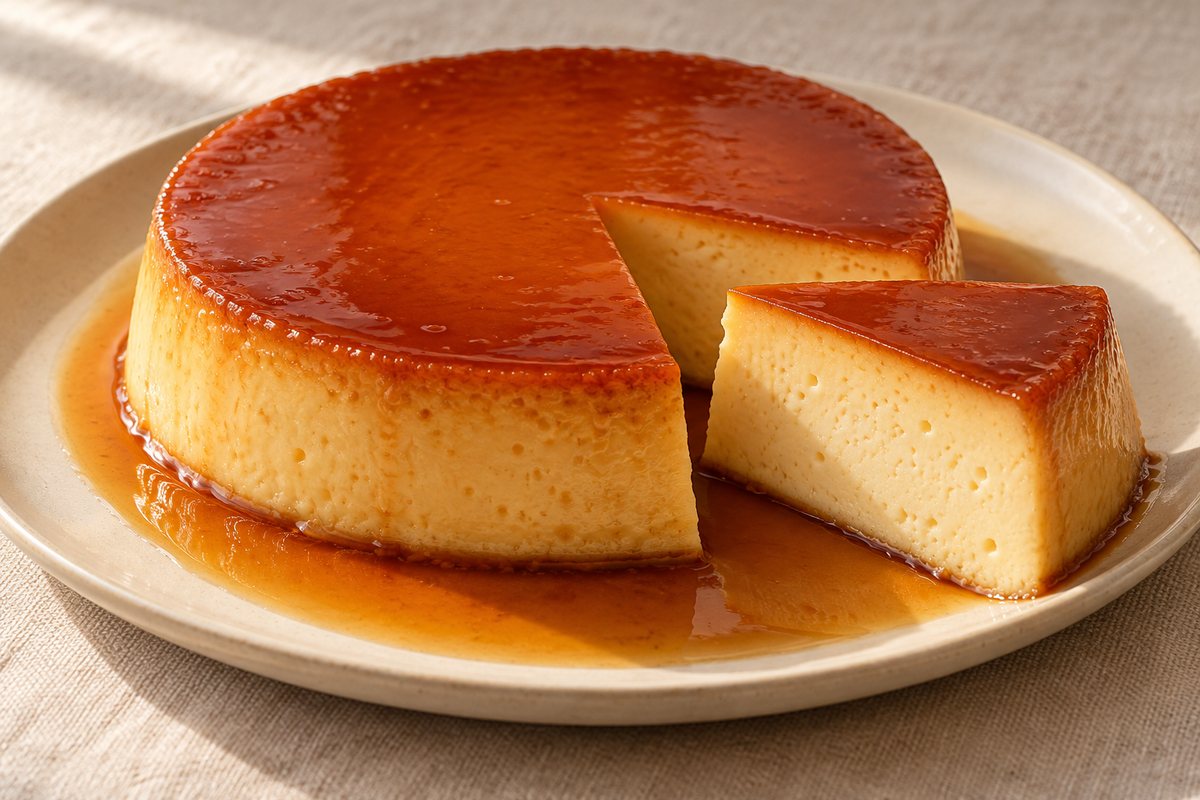
AI-generated illustration: Original AI depiction of caramel custard with a small wedge and caramel pooling. Consistency and baking texture have not been tested.
OpenAI · Usage terms
Image details
Uncropped proportional downscale from saved original PNG to 1200px maximum JPEG, quality-optimized.
Condensed milk is not evaporated milk
The can must say sweetened condensed milk. It supplies concentrated milk solids and sugar; unsweetened evaporated milk is not a direct replacement. This version also uses whole milk and whole eggs. It contains dairy and egg, and this formulation does not provide an egg-free or dairy-free substitute.
The recipe uses a measured 1 1/2 cups of milk rather than “one can” as a volume measure. A can’s printed 14-ounce weight describes the condensed milk, not 14 fluid ounces of any other liquid.
What makes this a quesillo
Venezuelan quesillo is a caramel custard, not a cheese filling despite its name. Maria Campos describes a firm custard with small holes. The whole eggs, milk and condensed milk create that family of texture; the number and size of holes vary with mixing and cooking.
This version uses vanilla without rum. Rum appears in the consulted recipes, but leaving it out avoids an unnecessary ingredient and does not change the amount of egg needed to set the custard. Do not beat extra air into the mixture just to imitate an illustration.
Use a safe pan and an even water bath
A dedicated quesillera can be convenient, but an oven-safe solid metal cake pan covered with foil is practical in a US kitchen. The outer pan must be roomy enough that you can add water and lift the inner pan safely. Do not put an ordinary cake pan directly on a stovetop burner to make caramel.
A water bath moderates the heat around the custard. Aggressive boiling and excessive cooking can make it grainy or rubbery. If the middle is not set, keep baking rather than relying only on the clock. A thermometer supplies the safety check; the gentle central wobble supplies the texture check.
Chilling, unmolding and leftovers
Unmolding warm custard risks a collapse. If the caramel remains attached but the custard has released, allow the plate to collect the liquid caramel that comes free rather than scraping hard sugar onto the top.
Refrigerate covered at 40°F or below and use within 3 to 4 days. Keep serving time out of refrigeration within 2 hours, or 1 hour above 90°F. The caramel syrup does not make a milk-and-egg dessert shelf stable.
Research sources
- Layla Pujol — Quesillo Venezolano (Spanish) (checked 2026-10-22)
- Maria Campos, The Cookware Geek — Venezuelan Quesillo (checked 2026-10-22)
- USDA FSIS — Shell Eggs from Farm to Table (checked 2026-10-22)
- FDA — Safe Food Handling (checked 2026-10-22)